
From Brush to Block
Story by Haley Watkins
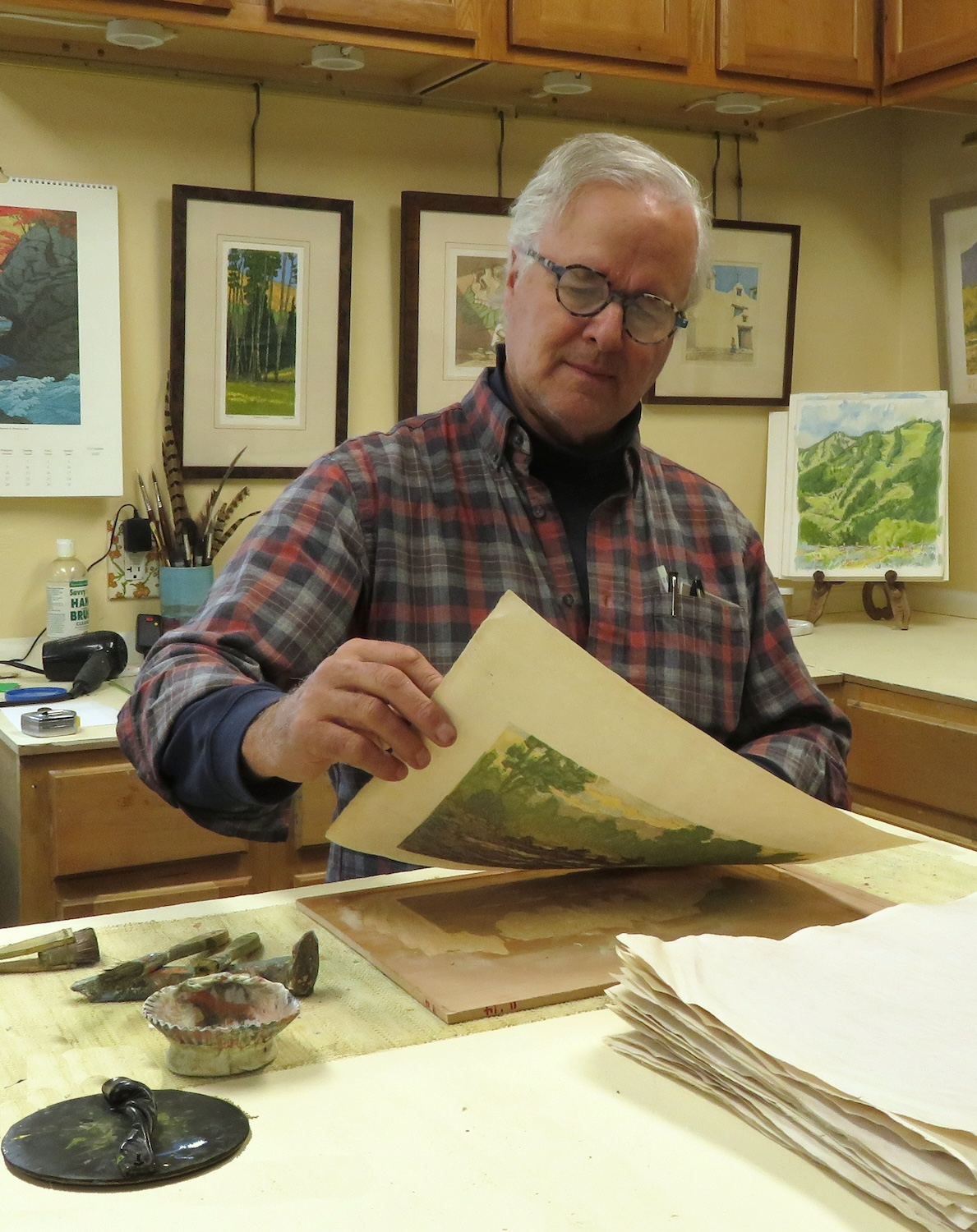
Leon Loughridge at home in his studio. Courtesy of Leon Loughridge.
Printmaking, for Leon Loughridge, isn’t just a process – it’s a form of storytelling, a painterly expression carved and printed by hand. The beauty of it, for him, is that it’s like painting. He begins with a watercolor, which acts as a roadmap – a guide to where he wants the added color to go. Just like in watercolor, the final result isn’t planned out stroke for stroke. He begins with a vision and solves problems along the way.
“True reduction is where I’m reducing the printing area of the block between each color run,” Leon explains. After printing one color, he carves away more of the block and prints the next, layering colors and carving as he goes. But his process adds a twist: “I’m using three blocks. So you could almost say it’s a multi-block reduction print. And that’ll get everybody totally confused,” he adds with a laugh.
A few years ago, his process changed significantly when he had to move away from using chemicals like mineral spirits and linseed oil due to serious health reactions. That shift led Leon to the Japanese method of printmaking called moku hanga – a process entirely based on touch and handwork. Instead of applying ink with rollers and running a block through a press, the artist uses a brush to apply a thin layer of ink made from water, rice paste and pigment. Pressure is applied using a circular disk, between three and five inches wide, with a slight texture – this tool is called a baren. Printing is done with moist, but not wet, Japanese paper.
“That moist paper really picks up the ink that’s on the raised surfaces of the block,” he says. Unlike a press, the baren allows artists to selectively apply pressure to just one area at a time. Leon can spot print, add accent colors, or apply a gradation to a sky he has already printed, giving it a transition from light to dark. For Leon, this makes the process feel even more like painting, always building toward the concept laid out in the original watercolor sketch.
Leon decides what to print by sketching outdoors. Carrying a day planner converted into a traveling studio, complete with a watercolor palette, brushes, paper and water container, he stops when something catches his eye, often on hikes.
"It doesn’t have to be a finished, perfect sketch. What I’m going after is either the value shapes or the color shapes – whatever it is that caught my eye,” Leon says. At the end of the day, he returns to the studio and looks through the sketches to see which ones hold interest. Sometimes he combines elements from different sketches – a top half from one, a bottom from another. The goal is always to be faithful to the mood of the scene by utilizing artistic interpretations. “I want to record what really moved me. What mood did I have when I saw this? That’s what I’m going after,” he says.
Raised in northern New Mexico on a ranch, then later in Aspen, Leon has always lived in the Southwest, which is why that landscape continues to inspire him. “It’s what I know. It’s where I’ve always lived,” he says. “Visiting new places, like a beach, takes time to adjust. It often starts with a few rough watercolors until I settle in and begin to see the landscape as shapes and colors.” But in the Southwest, the familiarity isinstinctual. All the quick sketches and observations made the outdoors become a knowledge bank – little tricks and tools for depicting grass against trees, light through leaves, mountain textures. He compares painting to writing: “You’re scratching something down,” he says. “It’s a very simplified view of what you saw, which is what you’re trying to convey to someone else.”
In printmaking, there’s a constant push and pull between control and unpredictability. “It’s kind of the yin-yang of printmaking,” he says. “If a print is too controlled, it begins to look rigid. But unpredictability alone lacks direction.” Control becomes a tool for pushing limits, avoiding formulaic repetition, keeping the work inspired. The uncertainty of the process becomes its strength. Often, he starts a print wondering, “Egads – what have I got going here?” Then, after pushing through a difficult section, he finds the rhythm again. “Okay, I think I got it. We’re on the right trail, and now it’s a downhill run,” he says. In that process, he’s thinking constantly about mood, mechanical steps, carving, color, value and temperature – all relating and building on what’s already on the paper.
The most meaningful print is often the one just finished. But one piece stands out: a woodblock titled “Above Bear Lake,” created after a winter trip to Rocky Mountain National Park. In the freezing weather, he did a quick watercolor sketch of the storm over the lake. “The watercolors don’t handle well when the water is freezing,” he notes. Back in the studio, he pinned it up and kept coming back to it. Eventually, he drew directly onto a block without any preliminary drawing or tracing and began printing immediately, building the image with reduction layering. The clouds were the focus – five layers of carving and color. Later, he realized a second block was needed for the warm colors of the trees. This process showed him just how versatile moku hanga could be. “The more you go down the rabbit hole, the deeper you get. And the more lost you get,” he says.
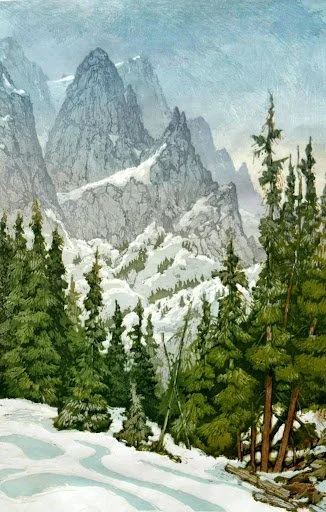
"Above Bear Lake," Leon Loughridge, Woodblock, 22" x 14"
Leon’s woodblock prints are very painterly – a word he uses to describe them all. Each one is slightly different because of the hand-applied ink, and each is treated as an original. “Just because it’s called a ‘print’ doesn’t mean it’s mass-produced,” he says. “This is all manual dexterity and knowledge that creates a way to transfer ink onto a piece of paper in different methods.” The process is quiet, deliberate, expressive – and deeply personal.
Leon’s woodblock prints are on display at Steamboat Art Museum through August.