
From the Canvas to the Page: Meet the Painted Words Winners
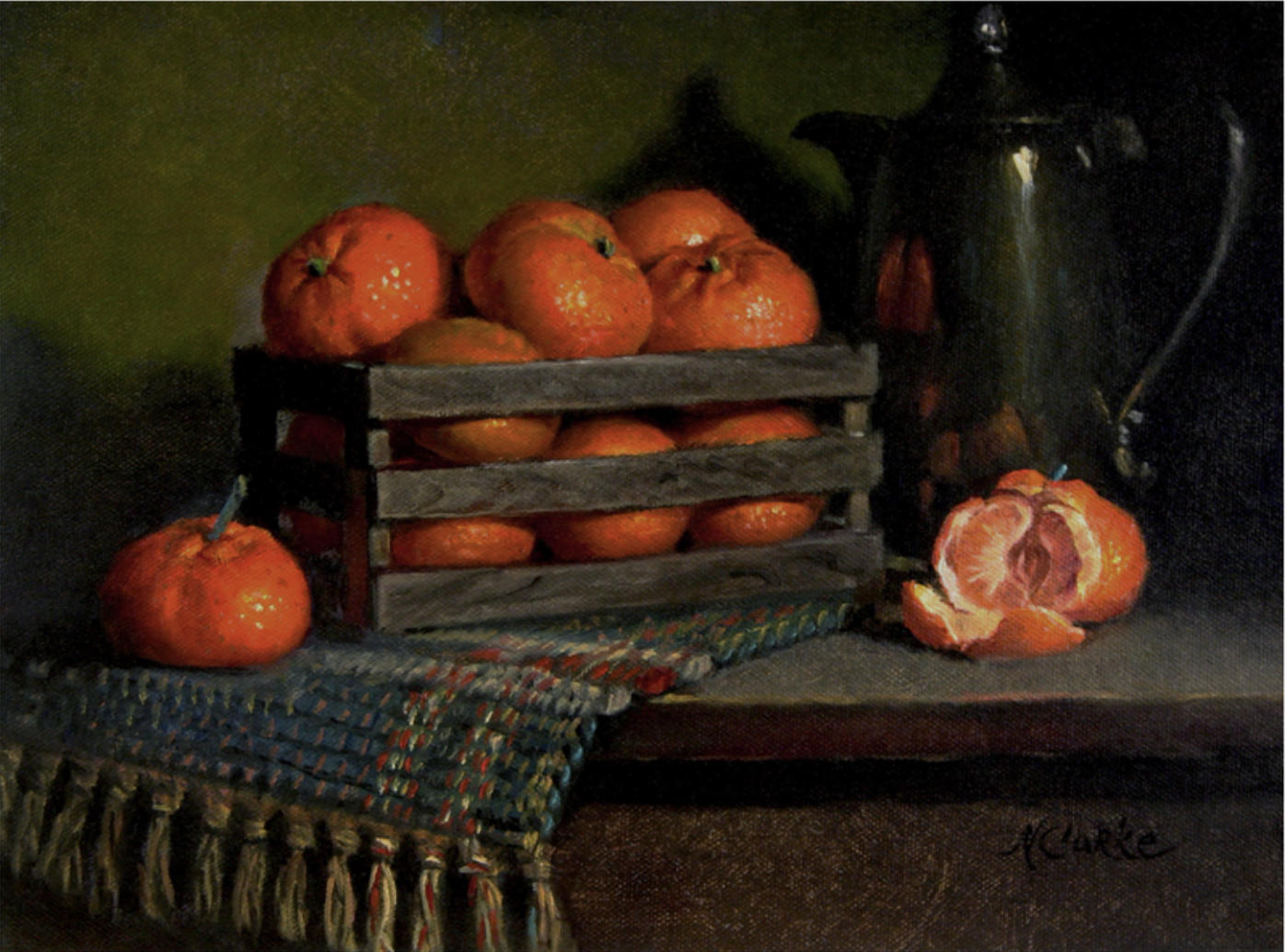
“Tangerines and Silver Coffee Pot,” by Natalia I. Clarke inspired the prose winner of this year's Painted Words.
A painting may begin with an artist, but its story doesn’t necessarily end when the brush leaves the canvas.
That idea is at the heart of Painted Words, a writing competition presented by Steamboat Art Museum and Ski Town Media, this year in conjunction with the museum’s Oil Painters of America exhibition. Writers were invited to choose a painting from the exhibition and respond to it in words, allowing one work of art to inspire another.
For winners Wendy Watson (prose) and Mary Yamamoto (poetry), that invitation led in very different directions. Wendy spotted a curious detail in a still life and followed it into a miniature murder mystery. Mary encountered the gaze of a young woman in a portrait and found herself drawn into a poem about yearning and memory.
Wendy Watson: A Tangerine Becomes a Clue
While considering the works in the exhibition, Wendy deliberately avoided paintings featuring people or animals. They offered ready-made characters, she thought, and might be obvious choices for other writers. Instead, her attention landed on the unfinished fruit.
Wendy’s “Tangerine Twist – A Mini Whodunit” was inspired by Natalia I. Clarke “Tangerines and Silver Coffee Pot,” a still life featuring a partially eaten tangerine beside a crate of whole fruit.
“Why would someone only eat a part of a tangerine?” she wondered. “Why didn’t they eat the rest of the fruit?”
Her own experience provided an answer. Wendy is allergic to oranges, something she discovered after repeatedly getting sick as a child after drinking orange juice before track practice. Today, eating fresh oranges or drinking orange juice can cause her throat to begin closing.
Combined with the painting’s dark shadows and what Wendy calls its “rather sinister looking coffee pot,” that history led her to imagine that the half-eaten fruit might not be as innocent as it appeared.
Soon, she had a murder weapon.
Real life supplied a victim. Wendy’s mother regularly lunches with a group of elderly women and often complains about one particularly talkative member who monopolizes the conversation. Wendy combined that anecdote with her citrus allergy and the painting, turning the partially eaten tangerine into the means of dispatching an annoyingly garrulous senior citizen.
The challenge was fitting the mystery into 500 words. There was no room for the conventional ending in which the culprit, motive and method are revealed. Instead, Wendy embedded clues in names and details and trusted the reader to figure it out.
The reader, she says, would have to become “the sleuth, judge and jury.”
Writing the story has permanently altered the painting for her. What once looked like an innocuous piece of fruit now demands closer inspection.
“Who’d’ve thought that the brightly colored fruit next to such a dreary little crate and coffee pot in that painting would be a murder weapon!” she says.
Wendy also discovered another benefit of fiction: Killing off a fictionalized version of an annoying person, she says, is “an excellent passive-aggressive way to deal with them.”
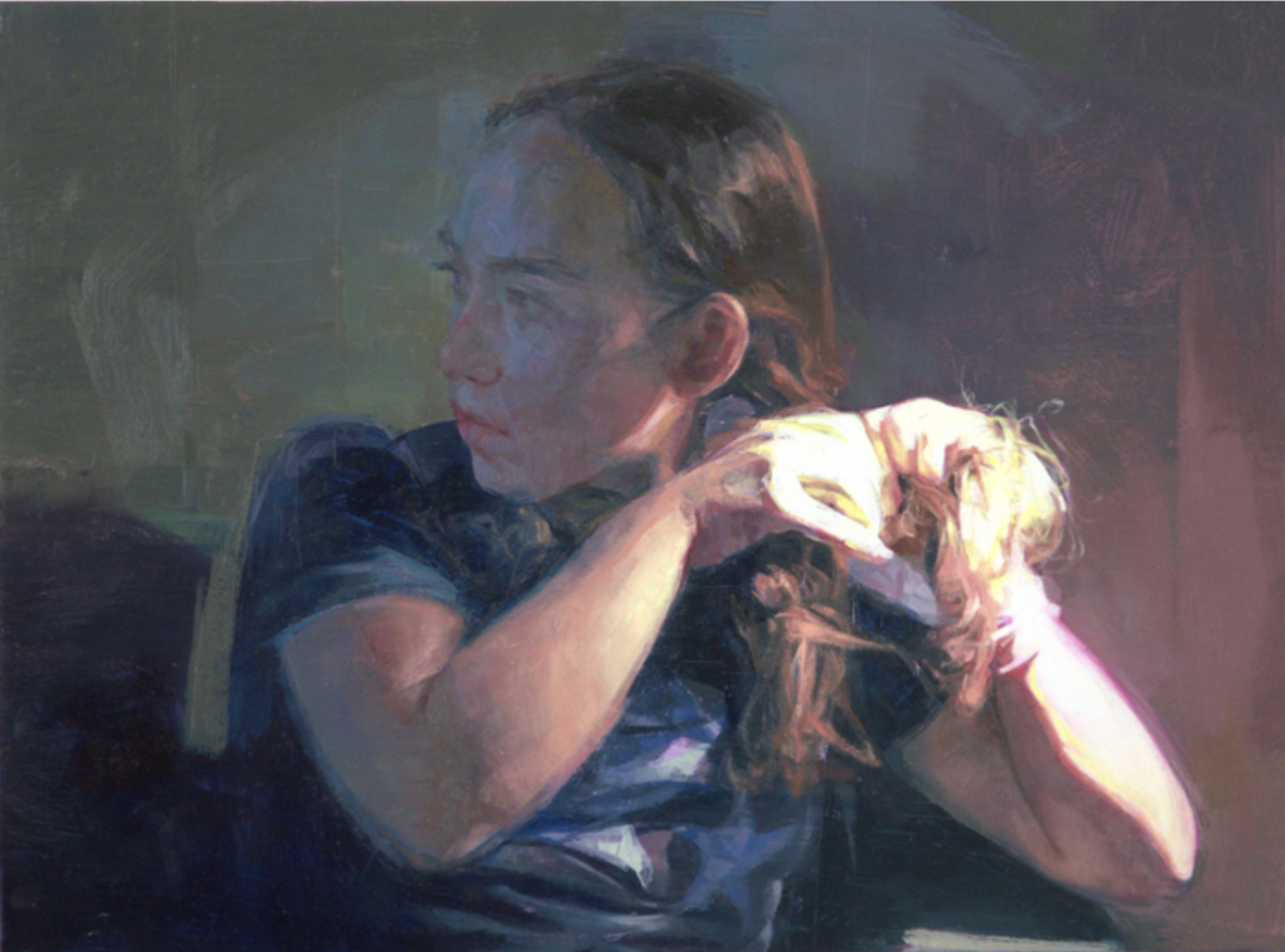
“The Light is Close” by Olena Burykina’s. inspired the poetry winner of this year’s Painted Words
Mary Yamamoto: Entering the Portrait
With a background in art, the printed word and music, Mary says art needs to “grab me and stir me up inside.” She went to Steamboat Art Museum determined to participate in the contest only if she found a painting that truly resonated with her.
Then she came upon Olena Burykina’s “The Light is Close,” a portrait of a young woman.
“I was immediately captured by the movement, the gaze of the young woman and the light at that very particular moment,” Mary says.
She went straight home and began writing.
Mary saw the woman as wistful, at an age when she might yearn for something more without yet knowing what was missing. The painting’s restraint also seemed naturally suited to poetry.
“Poetry uses words sparingly,” Mary says, “and there was definitely a quality of scarcity in the portrait.”
For the first time in Mary’s experience, the poem seemed to write itself.
But the painting also became personal. The young woman’s apparent restlessness reminded Mary of her own feelings at the same age, allowing the portrait to become a bridge to her past.
“The portrait wanted to tell its own story,” she says, “but I was also able to express the restlessness I felt at her age in my own past.”
Mary also found herself curious about Olena Burykina, who is originally from Ukraine, and how she came to live in Chattanooga, Tennessee. The dry, hot weather across the country at the time also influenced the poem.
Writing it deepened Mary’s connection to both the subject and the artist. Now, when she looks at “The Light is Close,” she feels transported into the room depicted in the painting, watching the moment unfold.
“It always feels alive to me,” she says.
A Creative Exchange
Painted Words adds another dimension to the experience of an exhibition. Instead of asking visitors only to observe and interpret, it gives them permission to create – to carry an image into another medium and make something new from the encounter.
The result is a creative exchange between painter and writer, even when the two may never meet. A canvas becomes a prompt, and the written response offers audiences another way into the original work.
In that sense, Painted Words extends the life of the exhibition beyond the museum walls, showing how one piece of art can become the starting point for another.