
Inside the Etching Studio
Story by Haley Watkins.
Up Elk River Road, near Hahns Peak Village, sits a beautiful barn built as an artists' studio haven. Filled with collections of art, and studios for both Shirley Stocks and her husband, Rich Galusha, the two have created something wonderful that embodies the past, present and future of their art.
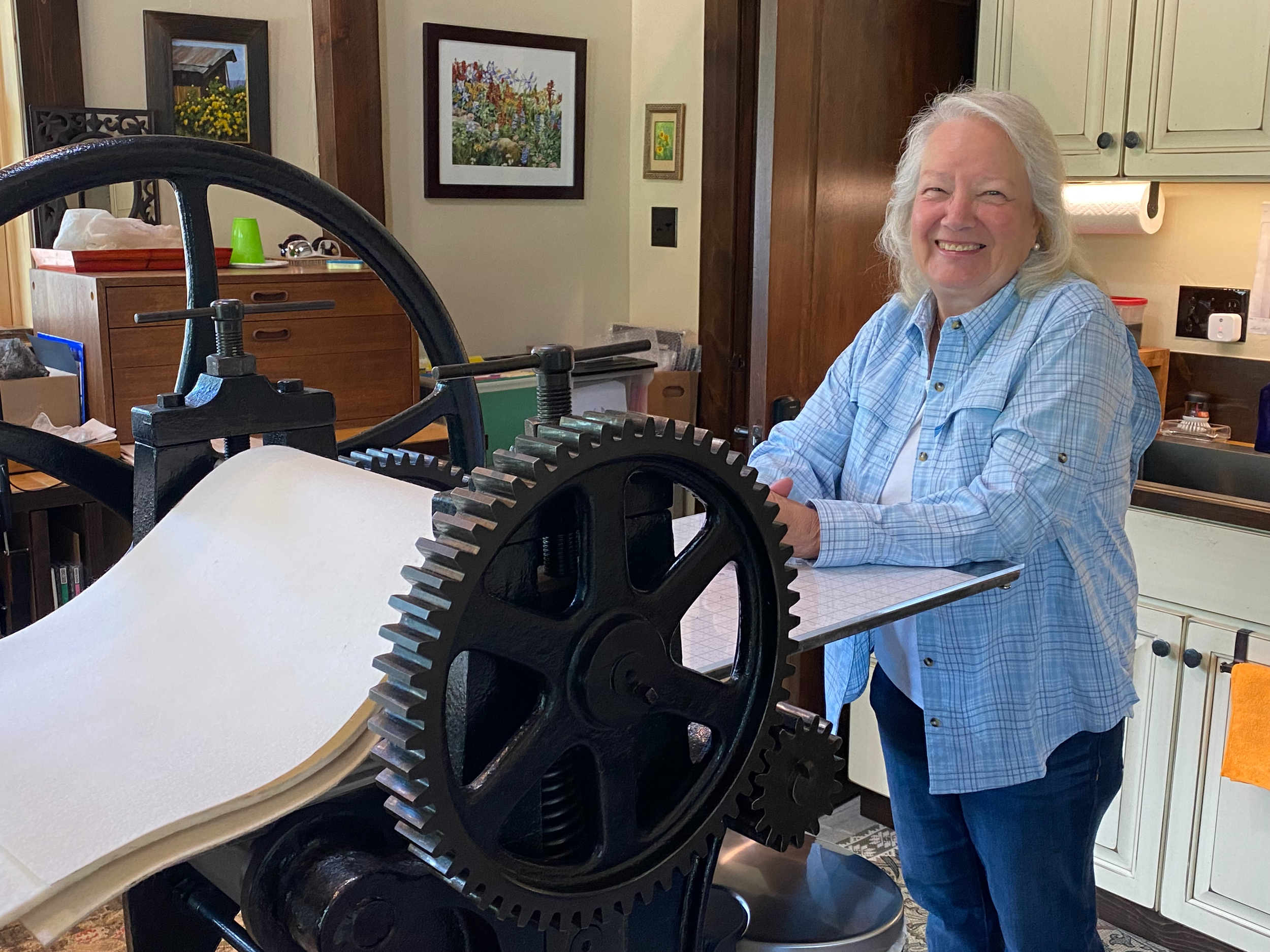
The studio houses a 1904 Sturgis press with thick, cast-iron gears and a surprising grace. “It is so much fun to work on,” Shirley says, beaming as she gestures to the big black machine that anchors the space. “The big gears work like a charm. There is nothing fancy about it but it is incredible because it is so well built.” After searching for nearly a year for the right press to fit her vision, she found one that was restored with care. It now lives in a dedicated etching studio, complete with running water and all of the amenities needed for production of a variety of printing techniques.
While her painting studio remains at her historic log cabin, this new space is designed specifically for printmaking – something Shirley first fell in love with during her time at Riverhouse Editions in the ’90s. Riverhouse was a collaborative hub where artists could gather, learn and create under the guidance of master printers. It was there where Shirley worked on massive copper plates and a variety of techniques honing her printmaking craft. Now, she prefers smaller pieces. The spirit of collaboration continues at Sue Oehme’s own studio today, even though the original Riverhouse no longer exists.
One gets an idea of her process glancing around the sunlit room. A drafting table near the window holds watercolored prints and works-in-progress. To one side sits a polished black stainless steel sink. Next to that, a row of small acid baths. Shelves hold rollers, inks and tubes of “BIG” – a safer, less toxic alternative to traditional asphaltum. She keeps three separate cloths for the wiping process, each with a different level of cleanliness, and her work surface bears the satisfying marks of many prints.
When she begins a new etching, it usually starts with a photograph or her drawing. She’ll edit it on her computer – turning it to black and white to better see the values, then flipping it so the final print will read correctly. From there, she draws the image by hand and prepares the copper plate with care: beveling the sharp edges, painting the back to prevent acid from eating through and applying her ground.
The techniques vary. She might use a hard ground, which requires baking, or experiment with soft ground drawing. “I’ve recently been exploring alternatives to powdered rosin for aquatinting – like pressing sandpaper onto the plate to create texture,” she says. “It’s way less toxic and I like how it prints.”
Her voice speeds up when she talks about the process. There’s a rhythm to it now: draw, etch, block out, scratch in. She shows a print made with layers of aquatint, areas blocked out with paint markers, and subtle drypoint details added at the end for sharpness. “I wanted just a little more detail, so I went in and scratched,” she explains.
Some prints are rich in color, others in texture. One piece – nothing but controlled scribbles – demonstrates how little precision is actually required to evoke emotion. Another, with deep, rich hues and exact registration, involved printing from two plates: yellow, green and red. “You have to line it up exactly,” she says. “It’s a challenge, which is probably why I like it. I don’t have as much control as I do when I’m painting with oils.”
This winter, she gave herself permission to experiment – to try different methods, tools and styles. The studio became a place of play and precision, memory and motion. She credits Sue Oehme, a renowned local master printer, for helping her get back into it. A few days working in Sue’s studio, and then together in Shirley’s studio, brought clarity and momentum. Sue is praised as a master printer – technically skilled, creatively bold and patient as a teacher. “‘You need to feel a little more soft with that,’ she might say, guiding with a firm but kind hand,” Shirley says. “She is an outstanding teacher and the best master printer I have ever worked with.”
A glance around the room reveals that everything in this space has a story. The press has history. The prints have layers. Even the furniture has character. There is no question: This is a working studio. But more than that, it’s a space where decades of skill, experimentation and passion come together, etched into every plate and pressed into every print.