
Noah Wetzel Tells All: How He Got His Solar Eclipse Shot
This August, Noah Wetzel’s photographs will be on display in Bliss Hall at the Depot Art Center. “Surreal Perspectives” features a mix of landscape and action sports imagery. Noah will also reveal several new pieces including “Eclipse Outlaw Chase,” which was part of a 250 hour project pursuing the total solar eclipse in April. Steamboat Magazine asked Noah, “Obviously the eclipse was a big moment of 2024 and there are many photographs of it. What went into capturing yours and how long did you plan for it? Also, how did you figure out exactly what you wanted to do and photograph during those four minutes?”
Noah Wetzel: Total solar eclipses are so rare, and you might only get one chance to view one in your lifetime. On July 29, 1878, nightfall struck Texas during the middle of the day. This occurred during a period where the wild West was alive, filled with dreams and despair. This particular total solar eclipse struck a portion of the west that was nearly impenetrable, a kingdom ruled by Comanche. A little further south, within the heart of Comancheria, endless rolling hills and bluffs are graced with persimmon oak, live oak, grasses, cactus and wildflowers. This is Hill Country: Llano County, Texas, a place where brutal battles were fought between the Comanches, Apaches, pioneers, and outlaws. Nearly 150 years later, on April 8, 2024, darkness would strike Texas during the day once again in the heart of Comancheria, Hill Country.
After shooting the previous total solar eclipse in Teton Valley, Wyoming in 2017, I was highly motivated to capture something unique that had never been seen before, and this would be my last opportunity to capture a total solar eclipse in America until 2044.
For over a year I had brainstormed concepts, but given the location, the time of year, and how high the sun would be in the frame, ideas were few and far between. The project began in January 2024 when the final concept came to mind on a sleepless night. Tossing and turning in frustration, I envisioned a surreal Western chase scene, a powerful visual and an ode to a foregone era filled with cowboys, outlaws and the settling of the West. Given how high the sun would be in the sky, I would need a wide landscape to be able to shoot a wide angle, thus I would need at least a few horses to fill the frame. Every detail was conceptualized. As a juxtaposition of culture during that period, I cast the female riders as the outlaws, painting a unique picture and allowing exploration within the viewer's imagination. Two lead outlaws and three chase riders were equipped with pistols and rifles. In this photograph, Lance and Stephanie Morris chase their twin daughters; also a planned metaphor of rebellious youth, and parents giving their children freedom to take the reins and ride off into the sunset.
Having never been to Texas, and not familiar with local landowners or equestrians, it took investigative reporting and a small miracle for all the puzzle pieces to align. From roughly 30 conversations and dozens of hours of research, to connecting with two private groups in March on a separate scouting trip, this project took everything I had in me. I reached out to the Comanche Nation, Osage Nation, added myself to equestrian groups in Oklahoma and Texas on Facebook, and in every single conversation that Texas, Oklahoma or Mexico was mentioned, I immediately questioned the individual. Believe it or not, one of the first leads I received was from a Steamboat connection, Steve Miura. The other connection was one of my last and was a Salt Lake City connection. In March, I flew down on that scouting trip to meet both groups and choose the best location.
There's so much effort and demanded experience that goes into these projects, and nothing is guaranteed. The project took 250 hours to complete. I can't even begin to explain how it was captured – so much work that brought me to tears multiple times, exhaustion, frustration and incredible overwhelming fear. Thirty different conversations logging every single lead and detail; mapping out distances on Maps and Google Earth; planning eclipse times; dozens of hours troubleshooting gear issues on nights of test shooting in March within the mountains; hours speaking with the best camera experts trying to find someone who would even understand what I was trying to do and how to do it; $5,000 of travel expenses; missed flights; $10,000 of additional gear purchased; $100,000 worth of camera gear, lighting gear and film equipment; 50 hours of driving; three nights of test shooting; two additional nights of test shooting with the horses to get them acquainted to darkness and the six powerful wireless flashes that would mimic the light from the eclipse; removing rocks and stones for the horse’s footing; cleaning up foliage…the list goes on and on.
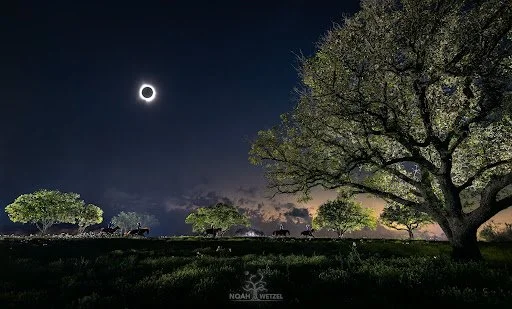
“Outlaw Night" by Noah Wetzel
What started off as a dream quickly turned into a nightmare that I couldn't get out of. I wasn't getting any closer to figuring out the complex lighting scenario. All I could focus on was constantly redirecting my focus to intently attempt to solve the problem. I just had to constantly breathe, letting out all the stress I was carrying, the empty pit in my stomach, and the elephant on my chest. It was the weight of a massive project that others were completely dedicated to and not getting paid for, dedicating their time and their experience to my idea. It was the most challenging experience I've ever had in my life.
With every day of test shooting, we figured out a little more, conceptualizing work-arounds for the issues that persisted. Finally, it came down to the day of totality, Monday, April 8, 2024. The forecast looked absolutely horrible and it seemed that we were more than likely not going to see the eclipse. I was fully prepared for that. I had planned a consolation image that we captured on one of the test nights which eased the pain a bit. That piece, “Outlaw Night,” was revealed this past month at Rumor Design.
In that scenario, there's only one thing to do: Prepare like it will happen. We woke up in the morning with 100% thick cloud cover. To be honest, it wasn't really stressful – that part, anyway. You know it's out of your control, and either way, it could be blue sky and you could have one small cloud block the eclipse, or it could be 100% cloud cover and you could have a hole in the clouds. Leading up to 1:30 p.m., the cloud cover started to become thinner, and about 20 minutes before totality, a few aspects of the clouds started to separate. Ten minutes before totality, the skies cleared directly above us, and we then had four minutes and 23 seconds to make a few attempts. I don't think I've ever experienced that much pressure in my life; it was absolutely f***ing intense. I had to be insanely hyper-focused and block everything out. I was managing a team of seven with five rolling cameras and two that I was shooting with. Every millisecond counted.
With two minutes to go before entering totality, I left my flashes on and my camera settings set to what I thought I would need during totality. I could only predict what settings (aperture, shutter speed, ISO and flash power) I would need. It was absolutely wild to watch it go from weird daylight at 98% eclipsed to complete darkness at 100%. Every 10 seconds, I fired a test frame to see if the exposure was adjusting correctly, to see if the flashes were starting to show up. Exactly as prepared for, as planned, it went dark and the flashes illuminated the scene like we practiced.
I only had three attempts, one of which was a very risky and bold attempt at an in-camera double exposure to increase the size of the eclipse within the frame. I risked everything for the best image. It took roughly 90 seconds for me to attempt that image, 90 seconds ticking away, precious moments that I could've attempted three additional normal attempts. I'll be revealing "Eclipse Outlaw Night" at the exhibition along with "Outlaw Night.”
Given my experience with eclipses, landscape imagery, action sports photography, wireless flash knowledge, long exposures, studio photography, and in-camera double exposure knowledge, I'm very confident that I'm one of a select few in the world that could have accomplished what I did, if not the only person in the world. It sounds bold, but that's what it was – it was intense.