
Meet Three of this Year’s Art in the Park Artists
Story by Amelia Davis
Normally scarce parking will be even more scarce on Saturday, July 13 and Sunday, July 14. A village of tents will be erected. And over a hundred artists and vendors will be out in the open air for one of the largest art festivals in Northwestern Colorado – it’s the 51st annual Art in the Park. The free event is a summer staple for locals and visitors alike, and fun for the whole family. The event will be held in West Lincoln Park and will run from 9 a.m.-5 p.m. on Saturday, and 9 a.m.-4 p.m. on Sunday. This year, Steamboat Magazine interviewed three artists; read more below.
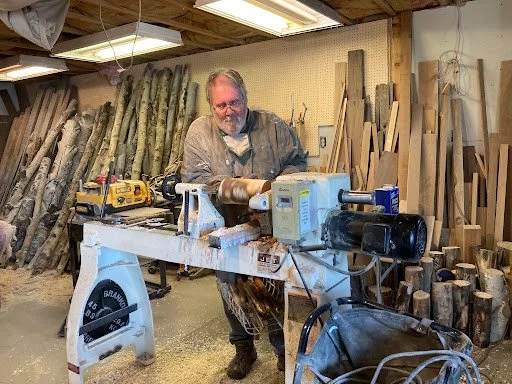
Russell Skinner is a woodworker who has transitioned from making furniture to using a lathe to make decorative trees and decorations.
Steamboat Magazine: You use Colorado aspen wood to make your pieces. How does the local sourcing of your material tie in with your creative and ethical vision for your art?
Russell Skinner: I use aspen in my work for several reasons: it is readily available and relatively inexpensive. It’s hard enough to take a crisp edge yet soft enough to not abuse me or my equipment. I like the idea that work created in Colorado is made with raw material that is sourced in Colorado and I really appreciate the irony of making trees from trees. Aspen has a rather short window of time when it is usable for me; too green and the wood tends to shrink and crack, dead for too long and it becomes crumbly and difficult or impossible to work. For this reason, I prefer to use standing dead trees. Currently, I am working with wood from property in Upper Cherokee Park, north of Red Feather Lakes near the Wyoming border. The land owner considers the tree removal as fire mitigation and healthy forest management; I consider it a convenient source of raw material.
SM: The imperfections of the wood add interest to the final pieces – how do you plan a piece? Is it based on the wood, or do you find wood to suit your ideas?
RS: I love imperfections in the wood, as do many of my customers. When the imperfections are obvious I do plan around them but you know the old saying, "Man plans, God laughs.” Frequently, the flaws or interesting grain are not visible until I start turning and so a planned tall tree might become a short one or vice versa; a tree intended to be one color becomes another; or even a planned tree becomes an unplanned vase. The best surprises are when I decide to finish a tree naturally; no color, no carving, no woodburning, because the character of the wood doesn't need any help from me; nature has already done especially nice work, thank you very much.
SM: What tools do you use to carve a piece, and how long does it take to finish one?
RS: The majority of my work is done on a lathe – all of the shaping and a minimum of nine stages of sanding. Some of the pieces are then colored using alcohol based dyes. Some trees receive what I call "the carpal tunnel treatment,” hundreds of strokes with a woodburning tool while still others have electricity passed through them to give a lightning strike effect. I am often asked how long it takes to make a piece; a question that I cannot really answer because I don't make them one at a time, start to finish. In a good week though, one without equipment breakdowns or too many spam calls or other distractions, I can make maybe fifteen, even twenty trees. Trust me, those weeks are few and far between.
I built custom furniture for more than 40 years and my work tended to be large and heavy. When I reached 65, wrestling sheets of plywood and heavy, lengthy boards began to lose all of its appeal. Through a combination of luck, serendipity and coincidence I developed my current processes and products as an alternative and I am having a blast with it. I work at least part of almost every day and, yes, I am tired when I get home. While sales are both validating and necessary, my favorite part of the process is seeing an unsolicited smile of delight from a customer approaching my booth for the first time.
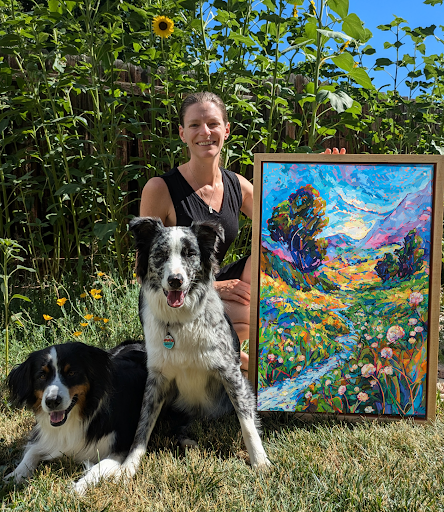
Mallory Cash, a painter, is known for using a palette of vibrant oil paints to create impressionistic landscape paintings that reveal more than a photo can convey.
Steamboat Magazine: How would you describe your style and what was the process of developing it? What are the strengths and weaknesses of the style?
Mallory Cash: I am known for my vibrant landscape paintings that are painted in the impressionistic style most popularly created by Vincent Van Gogh. Each of my paintings starts with going on an adventure into the great outdoors. That is where I take inspirational images that I later use as my muse in my home studio. There, I can reflect on the experiences I had in each location and create scenes that reveal more than a photo can convey. Each canvas is prepped with a thin layer of paint close to a terracotta color. Then I sketch out the landscape with a magenta color. From there I fill in the shapes and spaces with individual brush strokes of color. The downside of this style of painting is that each brush stroke is intentional and thus exercises my brain to the point of being tiresome. The perk of having the terracotta as the base color is that if I don't fill the canvas entirely with small vibrant brush strokes, I still have life shining through – which eases the process.
SM: What effect does your surroundings/town have on your art? Why do you choose to paint the subjects you do?
MC: I have chosen the place where I live carefully. I grew up in Florida and spent my summers in New Jersey. I went to college in Maryland – at the Maryland Institute College of Art – and continued to live in Maryland after graduating. All this time I didn't realize the east wasn't for me. It wasn't until 2017 when I moved into my self-converted van and traveled out west that I found true happiness. The towering mountains and red rock formations in comparison to the delicate wildflowers are where I find my muse. Hiking, rock climbing and camping allow me access to these inspirational places. In 2020 I moved out of my van to set roots in Colorado. It was a thoughtful decision. I continue to find inspiration in my backyard here in Loveland, Colorado as well as in the nearby hikes and camping trips I go on.
SM: What is one thing you would say all your works have in common, either stylistically or emotionally?
MC: My paintings are, without denial, portrayals of vibrant landscapes of real locations I have been to. As you spend more time with my art you will see that movement flows through each painting. May that be in a flowing river or stream, wind blowing through tall grass, shifting clouds in the sky or in the composition itself.
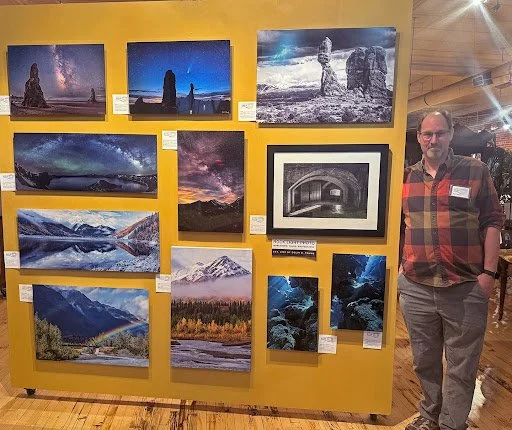
Colin Young is a photographer specializing in landscape and nature photography, with an additional focus on teaching aspiring photographers through his business, Rock Light Photo.
Steamboat Magazine: How did you get into the niche of nature photos when so many of the requirements are so prohibitive, either cost or timewise? What would you tell people who want to try it out?
Colin Young: Capturing photographs of the night sky creates a unique set of challenges. You need several things to go right to capture that first nightscape of the Milky Way: you need a dark night with little or no moon to wash out the Milky Way, a truly dark sky (well, away from city lights), clear skies (minimal clouds, no wildfire smoke), and the camera equipment to capture it. Luckily, camera sensors, especially in modern mirrorless cameras, are getting better and better at capturing low noise images, making it more accessible to a wider range of photographers’ budgets. You also need a good wide angle camera lens with the capability to open up the aperture wide enough to let in as much light as possible, because even on a 15-20 second exposure, we are trying to capture the light of stars in the core of the Milky Way more than 25,000 light years away!
I first got into Milky Way photography in the Adirondack Mountains of New York close to 15 years ago, but it was not until I moved out west with access to dark skies in Utah and Colorado that I began to have more success, and it became a focus of my work. These days I educate photographers in the secrets of capturing the night sky from all over North America – they travel to Estes Park, Colorado and Moab, Utah seeking dark sky opportunities they may not have at home.
SM: What’s the planning process of your pictures like? Do you travel often to certain places, or plan to capture certain weather or landscapes?
CY: Planning a specific landscape or nightscape photo shoot can involve a number of factors. If it is a location I have visited and scouted before, I may plan to visit at a certain time of year, whether that be during peak fall colors, snow melt in streams and waterfalls, or fresh snow. If I am planning night photography, I need to keep the time of year as well as the lunar cycle in mind. In June, the core of the Milky Way rises low and horizontal over the horizon to the Southeast just after sunset, but in September it is mostly vertical and more South-Southwest in the early evening. Knowing a location well makes it much easier to come back when the conditions are just right for that epic photo.
Of course, life would be rather dull if we just travel to the same locations over and over, so I am always looking for new places to explore. I make it a point to try to visit at least one new national park in the U.S. or Canada every year, knowing that I may have to come back two or three times to get the right conditions. My list of places on my photographic bucket list is sometimes exceeded by the list of places I have visited, but I need to come back when the weather is more conducive, the fall color is at its peak, or I have more time and energy to get up for that sunrise hike.
SM: Do you have a favorite season or subject to photograph?
CY: My favorite season to photograph has got to be autumn, when the fall colors are out, temperatures are cooler, fog can be more common, and days are shorter. Since the light for photography is best close to sunrise and sunset, longer nights mean I can do photography morning and evening, plus the night skies, and still manage some sleep. I am constantly delighted by the natural world, whether that’s a mountain lake, a red rock canyon, a dense forest grove or a lush waterfall, so favorite locations are hard to choose. Every location has potential – the trick is to unlock the potential of the location in front of me.
For more information on Art in the Park, visitwww.steamboatcreates.org.