
Welcome to the Madness: A Look Behind the Scenes
Opera Steamboat’s “Welcome to the Madness,” is a celebration and exploration of the history of the founding and founders of the Perry-Mansfield Performing Arts School & Camp. It will be performed on location, beginning in the Julie Harris Theatre – and traveling through the campus! – on Thursday, Aug. 22 through Saturday, Aug. 24 at 7 p.m., and on Sunday, Aug. 25 at 2 p.m. The immersive performance will move though three locations at the camp, the audience moving with it.
Commissioned by Opera Steamboat, this production represents five years of research, planning and hard work behind the scenes. Steamboat Magazine spoke with composer Leanna Kirchoff about the process of bringing this show to fruition.
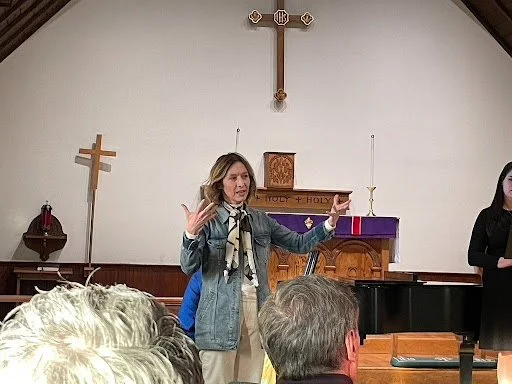
Courtesy of Opera Steamboat
Steamboat Magazine: First of all, before we dive into the performance, how did you start down the path to composition and scoring?
Leanna Kirchoff: I grew up north of Limon, which is about halfway between Denver and the Kansas border on I-70. So, rural Colorado. I grew up on a farm. We farm wheat and have some cattle. And so I really had a very rural experience, went to small schools. But I did always participate in music. There was a wonderful local piano teacher. I took lessons and just always had an affinity for that. And so I went to my first year of college and I just did general courses. I didn't know what my major was going to be, but I decided I wanted to pursue music. And so I did that. And I found myself – all music majors have to take theory – in music theory classes and oral skills classes. I just really enjoyed the creative projects that we got to do in theory. And then I took some lessons with the faculty composer that was teaching at the time, and decided that I should do a master's degree in composition. So that's when I really started to understand that it's more concert composition, not songwriting – it was more of a standard classical composition program. But I did love it and started on that path.
SM: You’ve been involved for about five years on “Welcome to the Madness.” What has the road from its conception to the upcoming show opening been like?
LK: In 2019, I went to the Opera America conference, and they were highlighting all of the granted projects. Opera Steamboat’s former artistic director Andres Cladera was there that year and he came up to me and said, “I have such an interest in having Opera Steamboat commission a new opera, and I would really like it to be by a female composer and maybe an all-female creative and production team.” Then there was a good period of research that Rachel Peters and I – Rachel is the librettist – the librettist usually does the work first, so Rachel came up with a plan of how we might create this story. It's a huge topic, because they have a hundred years of things that the camp has been doing, so she synthesized that into the most important things to celebrate about that story. Then the last couple of years has been me doing the music part of it. We've had two workshops in 2022 and 2023. We both had some small workshops on some parts of the music. So we've just been gradually piecing it together.
I really think it all came together when there was the collaboration with Perry-Mansfield itself, and I think Julie [Maykowski, general director and CEO of Opera Steamboat] has had – it seems like to me – a really productive and great collaborative relationship with them over these last 12 months or so to make it possible for us to do this opera at the camp in August. We'll start rehearsals on the 29th of July. And so for me, it's just so exciting. It's been a long journey. Operas are long journeys.
SM: What's it been like for you to work on a piece that is so firmly rooted in the history of this area, especially being a Colorado native?
LK: Oh, it's really fun to be able to work on a piece that I feel like I have several connections to. Oftentimes composers are working with people that are across the country or with situations that they don't have as much personal connection to. I grew up on the plains, but I do have the sort of rural aspect – that kind of connection. The DIY aspect of Charlotte and Portia, I feel like growing up on the plains, that we have that sort of built into our DNA – that self-sufficiency.
It's been fun getting to know some members of the Steamboat community. Each time I come up here, I stay with a different family and that's been so great. It's great to work on an opera that I can do in Colorado – I'm a native and hopefully Rachel and I have done it justice in the creative part. We've done a lot of consulting with Dagny McKinley, a local resident who has written the latest biography on Perry-Mansfield (“Perry-Mansfield Performing Arts School & Camp: A History of Art in Nature”).
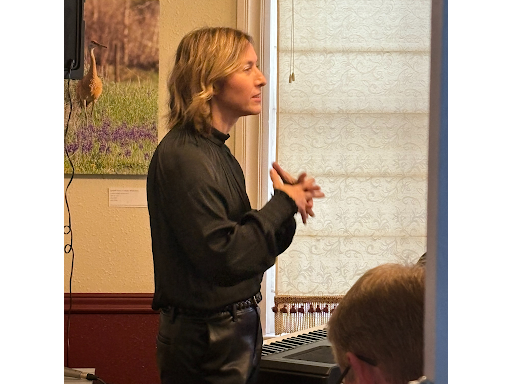
Courtesy of Opera Steamboat
SM: This is an unconventional performance in that it's moving and immersive. What was that like to compose for?
LK: Right now, the structure is that we will be in three theaters on campus. We'll start in the Julie Harris and do a big opening scene. And then we went outside the Julie Harris for a bit – there's a couple of scenes that are played outside. And then we move into the horse studio, which is not very far away. We play a couple of scenes there. And then the biggest move of the audience, singers, instrumentalists comes when we're moving from the horse studio over to the Steinberg Pavilion – we'll be there for the last third of the piece.
I brainstormed many different ways for it to work. I came to the conclusion that moving the instrumentalists is the hardest part. The singers – there’s no problem moving the singers because they move around all the time. The audience, it's doable. We can move an audience, and then let them sit down. It's the instrumentalists that we have to have, for musical support, and we can't have any gaps in the music from beginning to end. I decided on seven instrumentalists. That's a pretty small number for opera, which can, traditionally, have full orchestras. This is more of a chamber ensemble, but I did it that way because I needed them to be mobile. What I do is leapfrog the ensemble, where the full ensemble of seven is there in the Julie Harris at first. And then I move a few of those people outside to accompany the outdoor scenes while a couple of the other instrumentals move ahead to the next site. And then those two instrumentalists have a duet while the audience and the other instrumentalists move to the next site.
There's still things to work out, like making sure that the instrumentalists have a backing of some kind so that their sound can project forward. Once we get into the actual rehearsal process, there's still things that are a little bit up in the air. I've just given it my best guess of how we could make it work.
SM: You specialize in female-led productions and narratives. Do you feel like this performance is a natural extension of that in your work?
LK: I never really intentionally said I was going to set out to do a lot of work related to women's issues, it's just sort of that, one step at a time, those projects seem to come forward to me. And this one is an outgrowth of thinking about women's issues – and it's so exciting to do a piece that is completely celebratory; it doesn't have a dramatic arc. There's so many operas – and this is a thing in opera conversations about the role of the female character and the role of women in female operas as performers – there are so many operas in which something horrible happens to the lead female character or she's put in a terrible situation that she has to navigate. So it is fun to do an opera that is so celebratory of them being pioneers, visionaries, and of their openness to a lot of possibilities.
We're not delving into any of the hard things that maybe they faced, but I think opera probably in general has enough dark, heart-wrenching kinds of storylines that it's okay to celebrate, and in that it's also a celebration of the arts in general.
For more information and tickets, visitwww.operasteamboat.org.